Del Mar Electronics
Providing a Safe Passage Since 1986
GNSS
Global Navigation Satellite System (GNSS) is a collective term for satellite-based positioning systems that provide geolocation and time information anywhere on Earth. It works by using a network of satellites that transmit signals to receivers, which calculate their position based on the time it takes for the signals to arrive. GNSS includes several major systems such as the United States’ GPS, Russia’s GLONASS, Europe’s Galileo, and China’s BeiDou, along with regional systems like Japan’s QZSS and India’s NavIC. These systems are widely used in maritime navigation, aviation, land transportation, surveying, and personal devices to ensure accurate positioning and timing. GNSS enhances safety and efficiency by enabling precise route planning, collision avoidance, and integration with other navigation tools like ECDIS and AIS.
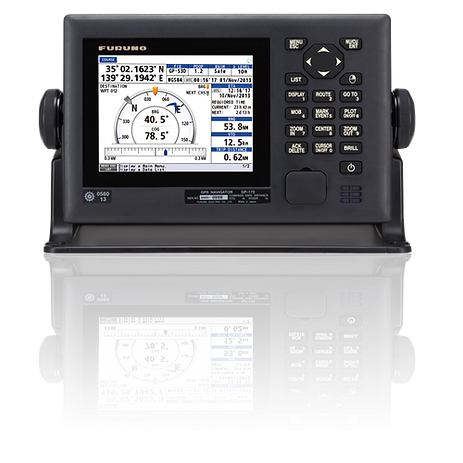
Furuno GP-170
Furuno’s GP170 is a highly stable and reliable position fixing system for ocean going ships, large yachts, ferries and commercial vessels. It is an ideal position sensor for Radar, AIS, ECDIS, Autopilot, Echo Sounder and other navigation and communications equipment. Its newly designed GPS chip and antenna deliver enhanced stability and precision in position fixing. Noise rejection capabilities are incorporated in the new receiver, delivering a high level of tolerance towards multi-path mitigation, which is further enhanced when the GPA020S or GPA021S antenna unit is utilized.
The GP170 is BAM (Bridge Alert Management) ready and boasts a variety of display modes, including Plotter, Course, Highway, Data and Integrity. The Integrity display mode delivers a highly accurate Skyplot presentation of currently viewable satellites, status on GNSS/SBAS signal reception including strength and SNR, and elevation angles of available satellites, as well as detailed information about available beacon stations.